

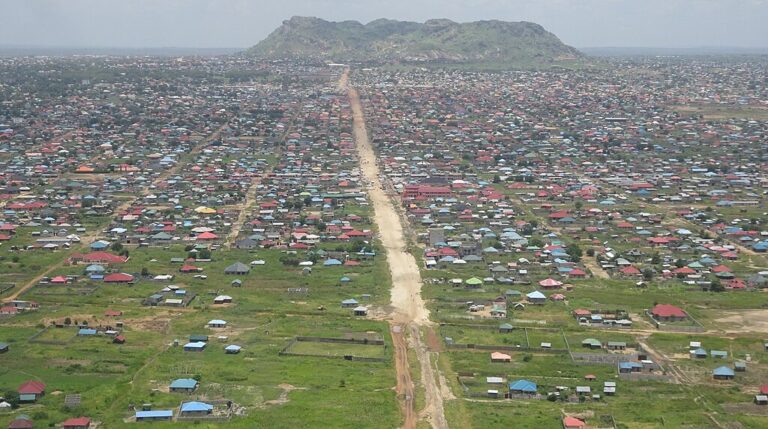
This blog by Wani James Henry, a natural resources and sustainability expert, and The Conflict Sensitivity Resource Facility (CSRF), highlights the significance of trees in Juba beyond the provision of shade and air quality, but as cultural, socio-economic and political meeting spaces over tea and coffee. The blog underscores the urgent need for Juba City to adopt a conflict-sensitive greening policy in the face of a looming climate crisis.
Climate stress in a fragile and economically unequal society
Urban communities in Juba are living proof that climate change is not a theory debated in air-conditioned conference halls — it is a daily sweaty reality. Severe droughts, heatwaves, extreme winds and floods are no longer seasonal surprises; they are regular guests overstaying their welcome in South Sudan. Between the months of November and March, walking in Juba is not a leisure activity. It is a test of endurance.
To take a simple walk under Juba’s scorching sun requires courage, motivation, and perhaps a farewell message to your deodorant. By the time you reach your destination, you are wrapped in a thick layer of sweat and red dust. The dust is democratic — it spares no one. It settles politely on your clothes, boldly on your face, and unapologetically invades your entire body. As a result, walking is mostly reserved for those pursuing survival — market vendors, students, and job seekers — while the few lucky individuals cruise in fuel-hungry Toyota V8 engines, with their oversized tires generously redistributing Juba’s dust to the rest of the populace. The unequal exposure to climate hardships reflects deeper structural and gender disparity, which is a topic for another day. When climate adaptation is absent or uneven, it can quietly contribute to grievance accumulation as economic inequality becomes more visible and perceptions over neglect deepen, resulting in frustration toward public institutions.
Trees as social connectors, not a mere decoration
Yet amidst the heat and the haze, there are heroes quietly standing their ground. The few scattered trees along Juba’s streets and around public buildings are not there merely for beautification; they are essential infrastructure. They provide shade that sustains one of the most vibrant informal economies in the city — roadside tea and coffee businesses run largely by women and younger girls. These shaded spaces also function as everyday peace infrastructure. They are connectors, bringing together people across economic, social, and sometimes political lines. Under these trees, life happens. Tea is brewed strong, conversations, even stronger. These shaded spaces are offices, networking hubs, and in some cases, what citizens jokingly describe as a “better-functioning parliament.” Here, issues affecting households, whole neighbourhoods and even national politics are debated with honesty and immediacy, all powered by affordable, spicy tea. Removing these trees does not just increase heat; it shrinks safe spaces for dialogue, weakens informal socio-economic networks, and reduces community interaction.
Why Juba must plant its way out of the heat
While regional cities such as Nairobi, Kigali and Kampala are investing heavily in urban greening to combat rising temperatures, improve air quality, and enhance urban livability, Juba appears to be moving in the opposite direction. In the past two years, schools have closed due to extreme heat. The warning signs are clear. The heat is not a one-time visitor; it is becoming a permanent resident. Yet there is little visible effort to build long-term climate resilience into urban planning.
Across the world, even cities in arid and desert climates are integrating urban forestry and green infrastructure into development strategies. Urban greening is no longer a luxury, but a cost-effective climate adaptation measure. For Juba, it is plain and simple; trees reduce urban heat, manage stormwater, improve air quality, enhance public health, create jobs, and support livelihoods. Besides, being a beautiful decoration, trees are climate regulators, and additionally for Juba, peace infrastructure.
As a peace infrastructure, urban greening in Juba presents an opportunity for strengthening social cohesion, protecting livelihoods, and building trust between citizens and public institutions. This stems from an earlier point made that under the trees is where socio-economic and political conversations and interaction happen. Although some arguments have been made on the negatives, which the tree planting programme should take into consideration – potential risks such as trees providing hideouts for criminals or illegal drug consumption, encouraging idleness, increasing the risks of trespassing, illegal settlements or conflicts over fruit trees – these risks are far ignorable to the benefits of having a greener Juba.
Conflict sensitivity considerations for green transition in Juba
To ensure that tree planting initiatives in Juba and South Sudan contribute to peace rather than unintentionally reinforcing divisions, the following considerations are proposed for greening initiative in Juba city.
Policy commitment. The government must integrate urban forestry into city master plans and enforce green space standards in public and private developments. This should be supported by a conflict-sensitive urban climate assessment. Such assessments should map out and identify dividers and connectors related to land use, neighbourhood inequality, and access to public services. The assessment should further identify areas historically perceived as marginalised or politically excluded, as well as understand gendered impacts, particularly on women-led informal businesses. Ensuring that greening policies consider how climate stress interacts with economic vulnerability and inequality ensures that greening efforts do not reinforce existing grievances.
Ensure equitable geographical distribution. Tree planting incentives in the form of budget allocations must cover high-density, low-income neighbourhoods, and not only central or elite areas. It should prioritise areas where informal livelihoods depend on shade, while applying transparent criteria for site selection to avoid perceptions of favoritism. Clear public communication and community engagement on the selection criteria can reduce suspicion and build legitimacy.
Create economic incentives for greening. Urban greening should strengthen, not disrupt, women’s income security. Protection measures and safeguards for women economic livelihood activities should be integrated into the initiative. Given that roadside tea and coffee vendors are largely women and younger girls, it would be important to consider involving women vendors’ groups in planning decisions, to protect existing shaded economic spaces during road construction, and designing of green spaces, in ways that safeguard their micro-enterprises. As part of the incentives to strengthen this formal micro economy, policymakers and climate actors should explore small grants and other support mechanisms linked to tree stewardship. In fuel-poor areas of Juba where people rely on firewood to cook but do not have money to buy charcoal, some may be forced to cut trees. In such contexts, the protection of trees is important as well as the provision of climate smart alternatives for firewood.
Strengthen institutional coordination. Greening initiatives should establish participatory governance mechanisms and create inclusive coordination platforms. These coordination platforms could involve city council representatives, environmental authorities, women vendors’ associations, youth groups, school administrations and local community leaders. Broader participation builds ownership, reduces risks of elite capture, and transforms tree planting into a shared civic project.
Link urban greening to youth employment. Tree nurseries, maintenance teams, and landscaping services can provide structured employment pathways for youth, reduce idle time in high-unemployment areas, and create visible economic dividends from climate adaptation. Youth inclusion could also reduce vulnerability to recruitment into violence or criminal activity.
Frame urban greening as a shared public good. Communication strategies should emphasise climate resilience as a collective benefit aimed at adults but also schoolchildren – the future generation. Trees shade should be understood as a public right, not a privilege and urban greening as economic protection and health improvement. Using climate stress as a unifying narrative can reduce polarisation and strengthen social cohesion. At the same time, planting trees should also be fostered in private compounds, in schools, and in public places. For posterity, schools could consider integrating tree planting and greening in school projects, through school clubs.
Plan and design greening as a long-term sustained engagement, not just doing ‘ceremonial planting’. Sustained greening should include selecting climate-resilient tree species, establishing nurseries, and developing maintenance systems that ensure planted trees survive. The practice of ‘ceremonial planting’ while it is good, has sometimes failed in terms of supporting planted trees to achieve their growth and maturity. Perhaps such projects should fall within the greening policies and benefit from the overall greening strategy. In cultures where certain tree species are respected for their significance, greening in such locations could maintain those species to benefit from cultural protection. At the same time, greening policies should consider not planting invasive species with negative impacts on the ecosystem.
Monitor unintended consequences. A clear feedback mechanism should be established to monitor perceptions of unequal benefit, displacement of informal vendors, land disputes arising from new green spaces, increased urbanisation or displacement that tend to accelerate tree cutting; and resolve any conflicts between communities and authorities. Adaptive management allows corrective action before tensions escalate.
Conclusion
Planting trees in Juba is not just about beautifying the city. It is about protecting livelihoods, safeguarding children’s education, improving public health, connecting people, and restoring dignity to the simple act of walking. However, if the residents of Juba continue the current path, Juba risks becoming a city where only engines move comfortably and humans merely endure the roasting heat and dust. But with deliberate policy actions, investment, and leadership, Juba can transform into a resilient, peaceful, and greener city, where shade is a public good.
The choice is simple – Juba can keep sweating through the heat crisis or plant its way out of it.
