

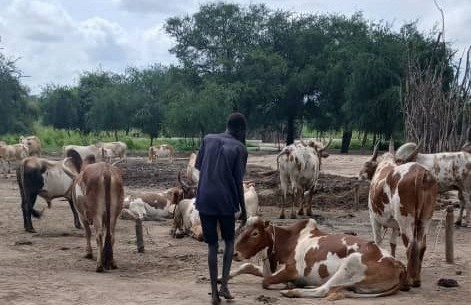
Photo Credit: Chuol Gew N. Ngeprial, August 2025
Summary
This blog examines dispute management practices among the Nuer of Geater Akobo. Focusing on the cattle compensation method, the blog finds that this longstanding customary approach remains the most credible and effective method for resolving disputes within Lou Nuer communities, with conflict-sensitive recommendations. The author recommends that aid programming should integrate existing local systems, including cattle compensation, into its peacebuilding approach.
This blog was written by Chuol Gew N. Ngeprial and the CSRF team.
Introduction
In the pastoral heartlands of Greater Akobo, South Sudan, justice among the Lou Nuer is not found in courtrooms but in cattle camps. When lives are lost, the community restores balance through blood wealth-compensation in cattle paid by the offender’s family to the victim’s kin. This practice, older than the modern state, remains the most credible and effective means of dispute resolution among the Nuer (Evans-Pritchard, 1940). At its core lies a philosophy of restoration rather than punishment. It reflects a worldview in which wrongdoing disrupts relationships and harmony, not merely breaking a law. Cattle, which are central to social, economic, and spiritual life, serve both as the instrument and symbol of reconciliation. Understanding this system is essential not only in appreciating Nuer culture but also for improving humanitarian and development work across Greater Akobo and similar pastoral contexts in other parts of South Sudan.
In the Nuer culture, conflict rarely remains individual. What begins as a personal quarrel can escalate into communal violence once a killing occurs. The victim’s relatives-often an entire clan-feel morally obliged to avenge the death. It is perceived that failure to retaliate may be interpreted as cowardice and can diminish a clan’s reputation. At the same time being feared for one’s willingness to avenge can deter future attacks. Without structured mediation, revenge can spiral into cycles of violence lasting generations.
Among the Nuer, individuals are extensions of their families and clans.[1] Parents, elders, and community members share collective accountability for their kin’s behavior. This shared liability acts as a social control mechanism. Young men know their families will bear the burden of their actions through cattle compensation (Dereje, 2009) which act as powerful social control mechanism. Violence is thus restrained not by fear of imprisonment but by the weight of communal obligation. The saying “Chi duar kach” [2] (“the mistake has jumped”) captures the shift in moral responsibility. Once death occurs, the focus moves from assigning blame on who started the problem, into restoring peace. The moral duty becomes that of rebuilding harmony, and not perpetuating vengeance nor blaming the deceased.
The Nuer Customary Law and Compensation
The Nuer believe that killing pollutes the soul of the offender, rendering them unfit to mingle with others until they are ritually cleansed. Whether the killing is intentional or accidental, the perpetuator becomes “unclean”; vulnerable to misfortune including death on the offender or his or her offspring. There is remedy to the offender’s misfortune though, i.e. the Kuar Muon [3] (Land priest) can do some rituals on the perpetuator on condition that the entire crime is confessed. In instances where a murder occurs secretly, the killer must confess to the Kuar Muon, who is duty-bound to inform the victim’s family. Concealing a killing is believed to bring slow death or misfortune upon the offender and his or her offspring. This belief ensures that murder cases rarely remain hidden. In an orderly Nuer village, there are no unknown killers, because the moral and spiritual order compels confession and cleansing before peace is restored
Blood wealth [4] is the cornerstone of Nuer customary law. It transforms death from a source of endless revenge into a path toward peace. Willingness to compensate is an acknowledgement of guilt, and it initiates reconciliation. It also helps expose any unknown killer since the Kuar muon, who is authorised to perform cleansing rituals for the perpetuators, has an obligation to reveal everything as part of the process. Compensation is also a way to transfer resources to support victim’s dependents or enable marriages that ensures the continuation of the deceased’s lineage. Compensation is expressed in cattle, which is the ultimate symbol of wealth, respect, and continuity. Although compensation rates vary across states, there are typical similarities in Greater Akobo – Nyirol, Uror, and Akobo Counties: Intentional killing attracts about 100 heads of cattle, open communal fighting, 51 heads of cattle, while accidental killing costs approximately 35 heads of cattle. The distribution of the cattle is also well stipulated, for example in the case of open killing where 51 cattle are paid: five go to a local authority, one is slaughtered by the Kuar Muon for ritual cleansing, one is taken by the Kuar Muon, and the remaining 44 cattle are given to the victim’s family and clan. [5] In an event where cash money is paid, the community insists that at least 70% of the compensation is in form cattle to preserve its cultural meaning.
Steps in the Nuer customary dispute resolution process
Temporary relocation. When a killing occurs, the offender’s family is relocated to a neutral clan respected by the victim’s family. This prevents immediate revenge and signals their willingness to reconcile. Relocation also indicates acceptance of responsibility and a show of respect to the victim.
Notification and mediation. Elders from the neutral clan communicate the incident to the victim’s family and convey the offender’s readiness to pay compensation. This step marks the beginning of transition from vengeance to peace.
Investigation and truth-telling. Respected elders from both sides conduct an open investigation, collecting witness testimonies or other evidence. The process is truth-and consensus-seeking, aimed at restoring moral clarity rather than imposing punishment.
Determining compensation rate. Once responsibility is accepted, elders determine the number of cattle to be paid based on common practice. Contributions are pooled across the perpetuator’s extended family for agreed time, symbolising shared responsibility. It is to be remembered that lack of compensation can cause revenge.
Ba-keth dak [6] and Transfer of cattle and ritual cleansing. The victim’s family is informed when the cattle are ready. With the help of chiefs and local authorities, a neutral meeting point is chosen. A ceremony named ‘dak keth ka’ – bile split ceremony – is performed, where a cow is killed randomly, and the others are transfer to victim’s family. The Kuar Muon performs this cleansing ritual, after which, free movement and interaction is permitted between the two feuding families or clans.
Distribution of cattle. The victim’s family typically divides the cattle, reserving many for dependants left behind by the deceased, or for ghost marriage, where one of the brothers or close a relative is chosen to marry and produce children for the deceased.
Ba Coa Tol (Breaking of the Bone). Among closely related families, a deeper reconciliation ceremony called Ba Coa Tol (“Breaking the Bone”) may follow. After compensation, both sides gather again to slaughter a cow. The bile, which is one of the vital organs in an animal, is used in the ritual of “breaking bone”. The bitter bile is mixed with water for the victim and perpetuators’ families to drink. This ritual, administered by the Kuar Muon, symbolises mutual forgiveness and restoration of trust.
Enforcement. Enforcement is social rather than coercive. Families that refuse to pay or reluctant to pay compensation can face public shame, exclusion from gatherings, or possible revenge attacks. In a society where belonging is everything, such sanctions are powerful deterrents.
Does the Nuer customary system work?
Despite its limitations such as gender exclusion, economic strain, and limited recognition by formal law, as well as its scrutiny in South Sudan by human rights activists, the Nuer customary law remains an effective indigenous conflict resolution mechanism.
Other limitations cited include the seeming failure of the customary system to regulate growth of militia groups such as the White Army, prevalence of small arms, unwanted behaviour such as alcohol and substance abuse, and a tendency to bless cattle raiding against other communities such as Murle.
However, local proponents argue that the 2018 conflict in Akobo, for example, was stabilised largely through intensified compensation efforts, with approximately 80% of cases settled through cattle compensation. They also reason that customary laws have held communities together particularly where there are gaps in the formal justice system or weak government institutions.
Further arguments for the system claim that it aligns with deeply rooted moral values including restorative Justice, collective accountability, accessibility, deterrence and spiritual closure.
Conclusion, and a link to conflict Sensitivity
Understanding local realities and customs is a key part of conflict sensitivity. The importance of cattle in the Nuer culture as discussed in this blog illustrates is critical when aid actors explore the use of cash programming, as substituting cattle for cash may inadvertently undermine existing community cattle agreements or provoke mistrust.
Aid interventions could also explore ways to collaborate more with customary structures-particularly elders’ councils, youth, women and Kuar Muon-to reinforce local legitimacy and respect cultural norms. In the era of aid reductions, working more to strengthen relevant indigenous systems, structures and institutions could contribute to local leadership and sustainability. Where there are aforementioned gaps such as gender exclusion or others, these could be challenged as addressed as part of capacity strengthening.
[1] “Clan” In the Nuer context: a clan is an exogamous, patrilineal kinship unit whose members trace descent from a common male ancestor (real or mythical), share collective obligations, and act as a social, political, and conflict-regulating group within the wider lineage system.
[2] Chi duer kach (the mistake has jumpted): ci duer Kach — A situation in which the original conflict may have been initiated by the eventual victim, but because that party is now dead, responsibility or blame becomes attributed to the surviving opponent.
[3] Kuar Muon is a land priest, who is a custodian of customary law, responsible for guiding traditional procedures and performing the rituals associated with compensation following a death.
[4] Cattle that is paid to the family or clan of the victim by the offender’s family of clan as compensation for the deceased.
[5] This distribution structure is under Fangak law, widely observed among the Lou Nuer.
[6] Ba Keth Dak: Ba kɛth dak — A compensation ceremony in which prescribed rituals are carried out and cattle are formally transferred to the family of the deceased or injured party.